How to Identify Carl Jung and Shadow Work Integration: Practical Self-Diagnosis Exercises
3 exercises to identify your shadow: the list of what irritates you most, an envy journal, and asking someone you trust what you avoid seeing in yourself.
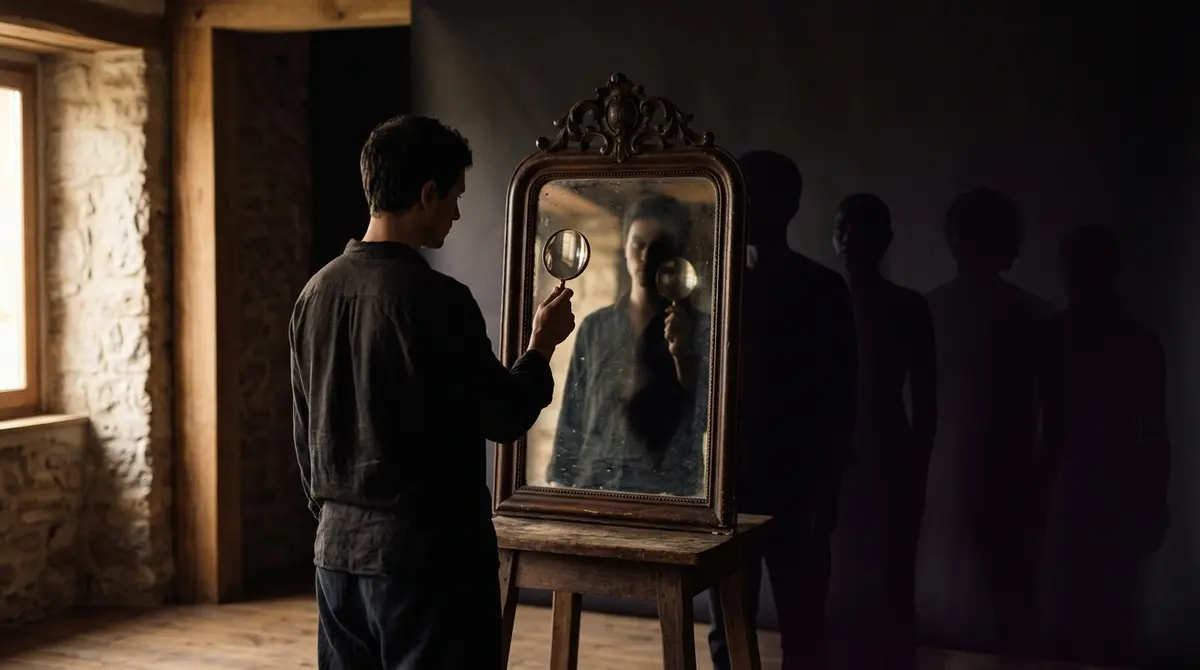
1. Make a list of what irritates you most
Write down 5 personality traits you find especially unbearable in other people — not illegal or harmful behaviors, but character traits (arrogance, dependency, showing off). For each one, ask yourself honestly whether you ever act similarly, even in a subtler way or a different context.
2. Keep an envy journal
For a week, note every time you feel a pang of envy toward someone, without editing yourself. At the end of the week, look for the pattern: what do those people have in common? It usually points to a desire or capacity of your own you don't let yourself openly acknowledge.
3. Ask someone you trust
Ask someone who knows you well and whom you genuinely trust to tell you, honestly, what trait of yours you avoid seeing or acknowledging. The shadow is, by definition, a blind spot — sometimes it's only visible from the outside.
How to know whether you are seeing shadow, not just preference
Identifying the shadow does not mean suspecting every irritation. Sometimes something bothers you because it really violates a boundary, contradicts your values, or puts you in an unfair situation. The Jungian clue appears when the reaction is disproportionate, repeated, and tied to identity: you do not simply think "I dislike this," but "that person should not be like that," "I would never do that," or "I cannot stand that way of being in the world." That emotional excess often means you are not only looking at the other person; you are also touching a part of yourself your self-image keeps out of sight.
That is why the three exercises in this article work best when you use concrete scenes. Do not write "arrogant people annoy me" and stop there. Ask who was present, what they said, what you felt in your body, what inner sentence appeared, and which part of you would not be allowed to behave that way. Arrogance may hide your difficulty taking up space. Neediness may touch your fear of needing anyone. Exhibitionism may activate a creative impulse you learned to hide so you would not seem too intense.
The shadow does not only contain "bad" traits. It can also hold power, ambition, sensuality, tenderness, leadership, play, rest, clean anger, or the wish to be recognized. Jung used shadow for what remains outside conscious personality, not only for what is morally rejected. A thin SEO article often loses this nuance and becomes a list of flaws. A stronger self-knowledge article uses the concept to recover information: what energy has been exiled, what purpose repression once served, and how that energy could return in a mature form.
The difference between judgment, envy, and projection
Intense judgment often points to an inner prohibition: something you do not allow yourself to be, feel, or express. Envy often points to a half-recognized desire. If you envy someone who is visible, it does not mean you want to copy their life; it may mean you want a freer relationship with your own visibility. If you envy someone who rests without guilt, you may not want their exact routine, but you may want permission to stop justifying every pause.
Projection appears when you place an emotional charge on another person that also lives in you. This does not mean "everything is your fault" or that the other person's behavior does not matter. It means the intensity of your reading may be amplified by your own material. A useful sentence is: "The thing I condemn most in this person, how does it exist in me as an impulse, fear, desire, or possibility?" The answer is often uncomfortable, but it is also useful.
| Signal | Useful question | Risk if ignored |
|---|---|---|
| Intense judgment | What trait am I not allowed to show? | Turning a part of yourself into an external enemy. |
| Repeated envy | What desire of mine is another person living? | Disguising a legitimate longing as moral criticism. |
| Shame | What would happen if someone saw this in me? | Continuing to act from an exhausting mask. |
How to do the exercises without turning against yourself
Shadow work needs honesty, but it also needs safety. If you do the exercises from self-punishment, you only strengthen the mask: a part of you learns that looking inward is dangerous. Before writing, slow down. Notice your feet, breath, and muscle tone. Choose a manageable scene, not the most painful memory of your life. If an emotion becomes too intense, return to the present: look around the room, name five objects, and leave the exercise for another moment.
A good practice does not end with "I am terrible." It ends with a more complex sentence: "a part of me learned to hide this," "this trait scares me because I associate it with rejection," or "I need an adult way to express this energy." That shift in language matters. The shadow integrates when it stops being a verdict and becomes information you can use to choose better.
After one week, review your notes for patterns, not isolated anecdotes. If three different people irritate you because they "take up too much space," the topic is probably not only them. If envy appears around people who publish, lead, charge money, or rest, you have a route for investigation. The next step is not imitation. It is testing a small, regulated version of that energy: ask clearly, show a piece of work, rest without apologizing, or say no before resentment builds.
How to interpret your notes without turning them into a label
When you finish the exercises, avoid searching for one neat conclusion such as "my shadow is arrogance" or "my shadow is dependency." It is more accurate to describe a relationship: "I struggle to take up space without guilt," "other people's need bothers me because I do not allow myself to need," or "I judge ambition because I associate it with losing tenderness." That kind of wording preserves nuance and prevents inner work from becoming another rigid identity.
It also helps to distinguish between personal shadow and a healthy boundary. If someone manipulates you, disrespects you, or invades your privacy, you do not need to turn everything into a lesson about your unconscious. Protect the boundary first. Later, when there is calm, you can ask why that scene affected you in a particular way. This order matters: safety first, interpretation later. Skipping it often leads people to justify harmful behavior in the name of self-knowledge.
A useful closing question is: "What small part of this trait could I integrate without betraying myself?" If attention-seeking people irritate you, you may not need to become intrusive; you may need to practice asking for recognition when you have done something valuable. If you envy someone who says what they think, you may not need to speak without a filter; you may need to express one pending truth in a safe conversation. Integration does not copy the extreme. It recovers the useful energy and puts it in service of a more whole version of you.
If you want a practical sign of progress, notice whether your reactions become less dramatic. Not because you stop feeling, but because you recognize sooner which part of you is involved. That second of awareness already changes the scene: it lets you respond with more choice and less automatic self-protection.
- The traits that irritate you most in others are the most direct route to your own shadow.
- A repeated envy pattern points to an unacknowledged desire of your own, not just social comparison.
- The shadow is a blind spot by definition — an outside perspective from someone you trust is irreplaceable.
Discover your complete profile
If you want a personalized reading of the 13 dimensions + 4 annexes of your mind, start the self-knowledge test for free.
References and Bibliography
Selection of sources used as conceptual background for this article.