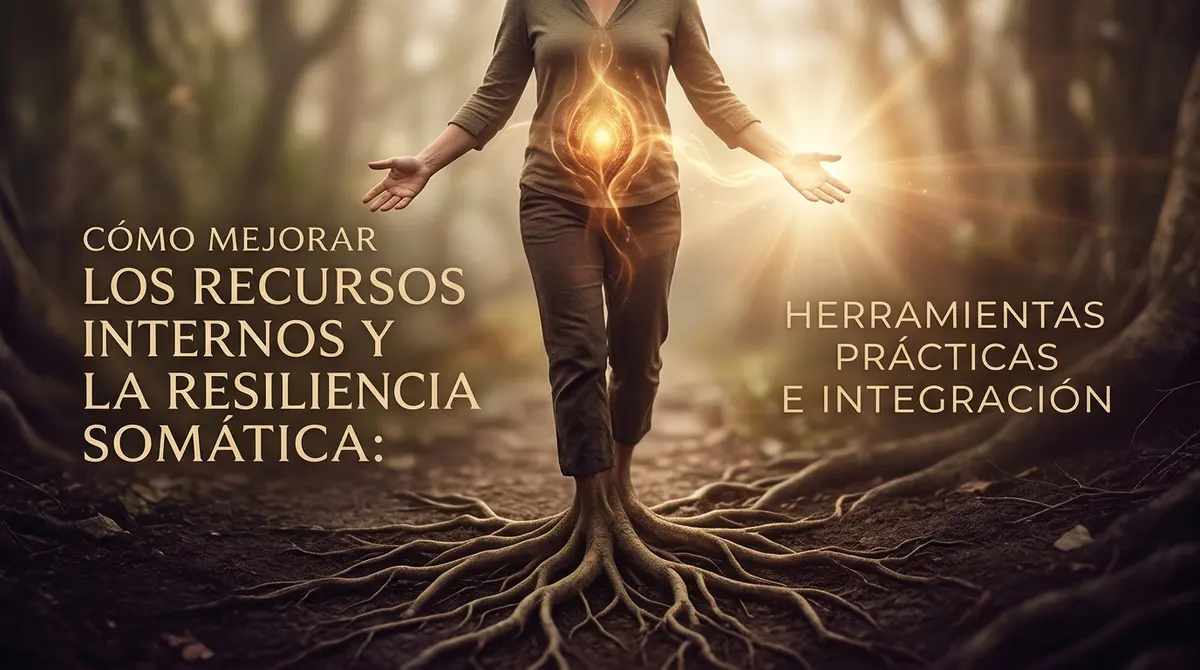
How to Improve Internal Resources and Somatic Resilience: Somatic Tools and Integration
4 techniques to strengthen your resilience: ask for help before the limit, practice alternative interpretations, and reconnect with your sense of purpose.
1. Ask for help before the limit
Identify one concrete early sign that you're overwhelmed (sleeping poorly, irritability, isolating) and commit to reaching out to someone on your support list as soon as it appears, instead of waiting until the situation is unsustainable.
2. Practice alternative interpretations
Facing a difficult situation, deliberately write three different readings of what happened, even if the first is the most automatic one. This exercise trains cognitive flexibility even when no alternative feels fully convincing at first.
3. Train self-regulation with brief daily practice
Spend 5 minutes a day on a regulation practice (breathing, brief movement, a conscious pause) during calm moments, not only during a crisis. Self-regulation is a capacity that trains best outside the moment of peak activation.
4. Reconnect with your sense of purpose
During difficult stretches, take a moment to explicitly name which value or relationship sustains your motivation, even if the immediate problem has no clear solution yet. Naming the purpose doesn't solve the difficulty, but it sustains the energy to get through it.
Improving resilience means building usable resources
Improving internal resources and somatic resilience is not about becoming someone who can tolerate unlimited pressure. That version of resilience sounds strong, but it often turns into burnout with better branding. Real resilience is the capacity to recover, reorient, and choose a workable response after stress has affected you. It includes the body, the mind, relationships, and meaning.
The practical question is not "How do I become tougher?" but "Which resource is missing in this moment?" Sometimes the missing resource is rest. Sometimes it is cognitive flexibility, social support, a clearer boundary, emotional processing, food, movement, or a sense of why the effort matters. When you identify the specific missing resource, improvement becomes concrete instead of motivational.
Somatic resilience adds one important layer: your body gives information before your thoughts become clear. Poor sleep, irritability, tightness, shallow breathing, shutdown, or the urge to isolate may be early signs that your system is running out of margin. Listening earlier prevents the cycle from becoming a crisis.
Four practices that strengthen resilience
| Practice | Use it when | What to notice |
|---|---|---|
| Ask before the limit | You notice irritability, poor sleep, or isolation. | Whether support reduces the pressure before crisis. |
| Write three interpretations | Your first reading is catastrophic or rigid. | Whether another view creates one more option. |
| Train regulation while calm | You want tools available during stress. | Whether breathing or movement becomes easier to access. |
| Name the sustaining value | The problem is not solved but you need direction. | Whether meaning helps you keep a human rhythm. |
A seven-day integration plan
For one week, choose one difficult moment per day and record the trigger, body signal, coping strategy, and result one hour later. The last detail is important. Some coping strategies feel useful for five minutes but leave more shame, avoidance, or exhaustion later. Others may feel uncomfortable at first, like asking for help or setting a boundary, but create more recovery afterward.
Then choose one practice to repeat, not ten. If the main pattern is isolation, practice one specific request for support. If the main pattern is overthinking, practice writing three interpretations. If the main pattern is shutdown, start with gentle movement and sensory contact. If the main pattern is losing motivation, reconnect the task with a value or relationship that matters.
Common mistakes while improving resilience
One mistake is using resilience to avoid changing conditions that need to change. A breathing practice can help you speak more clearly, but it should not replace a necessary boundary. Another mistake is waiting until you are already overwhelmed to use support. Social support works better before the limit, when the system still has enough room to receive it.
A third mistake is judging progress by constant calm. Resilience does not remove fear, grief, or frustration. It changes what happens after they arrive. If you recover sooner, ask earlier, choose more precisely, and create less secondary damage while stressed, your resources are improving.
It also helps to separate endurance from recovery. Endurance may be necessary for a short emergency, but if your whole identity is built around enduring, you may miss the moment when the body needs repair. Recovery is not a reward for being strong enough. It is part of the resilience cycle. Without recovery, coping strategies become thinner, more defensive, and more automatic.
Use a simple resource audit at the end of the day. Ask: did I have enough sleep, food, movement, emotional expression, support, structure, and meaning today? You do not need a perfect score. You need to see which resource consistently drops first. If support is always missing, the improvement plan should include one request. If structure is missing, the plan may be a shorter task list. If meaning is missing, reconnect the effort with a value instead of pushing harder.
When practicing cognitive flexibility, do not force yourself to believe the most positive interpretation. The goal is not optimism. The goal is to loosen the grip of the first automatic story. For example, "They did not answer because they hate me" can become "They may be busy," "I feel insecure because waiting is hard for me," or "I can ask directly instead of guessing." Even if the new interpretations do not feel fully true, they create enough space to choose a less reactive action.
Resilience also grows through repair after imperfect coping. If you snapped, withdrew, overworked, or avoided asking for help, review the moment without turning it into a self-attack. What signal did you ignore? What resource was missing? What would be one earlier cue next time? This kind of review turns mistakes into training data. Shame closes the learning loop; curiosity keeps it open.
At the end of the week, look for one measurable change rather than a perfect transformation. Did you ask for help earlier? Did you recover faster after stress? Did you choose one boundary instead of pushing through resentment? Did you use a body signal as information before the situation escalated? These are realistic markers of progress. Resilience is built through repeated small recoveries, not through a single heroic moment.
- Asking for help before the limit is more effective than waiting for a crisis to activate social support.
- Cognitive flexibility and self-regulation train best during calm moments, not in the middle of a crisis.
- Naming your sense of purpose sustains motivation even when it doesn't solve the immediate problem.
Discover your complete profile
If you want a personalized reading of the 13 dimensions + 4 annexes of your mind, start the self-knowledge test for free.
References and Bibliography
Selection of sources used as conceptual background for this article.
- Connor, K. M., & Davidson, J. R. (2003). Development of a new resilience scale: The Connor-Davidson Resilience Scale. Depression and Anxiety, 18(2), 76-82.
- Folkman, S., & Lazarus, R. S. (1984). Stress, appraisal, and coping. Springer.
- Luthar, S. S., Cicchetti, D., & Becker, B. (2000). The construct of resilience. Child Development, 71(3), 543-562.